


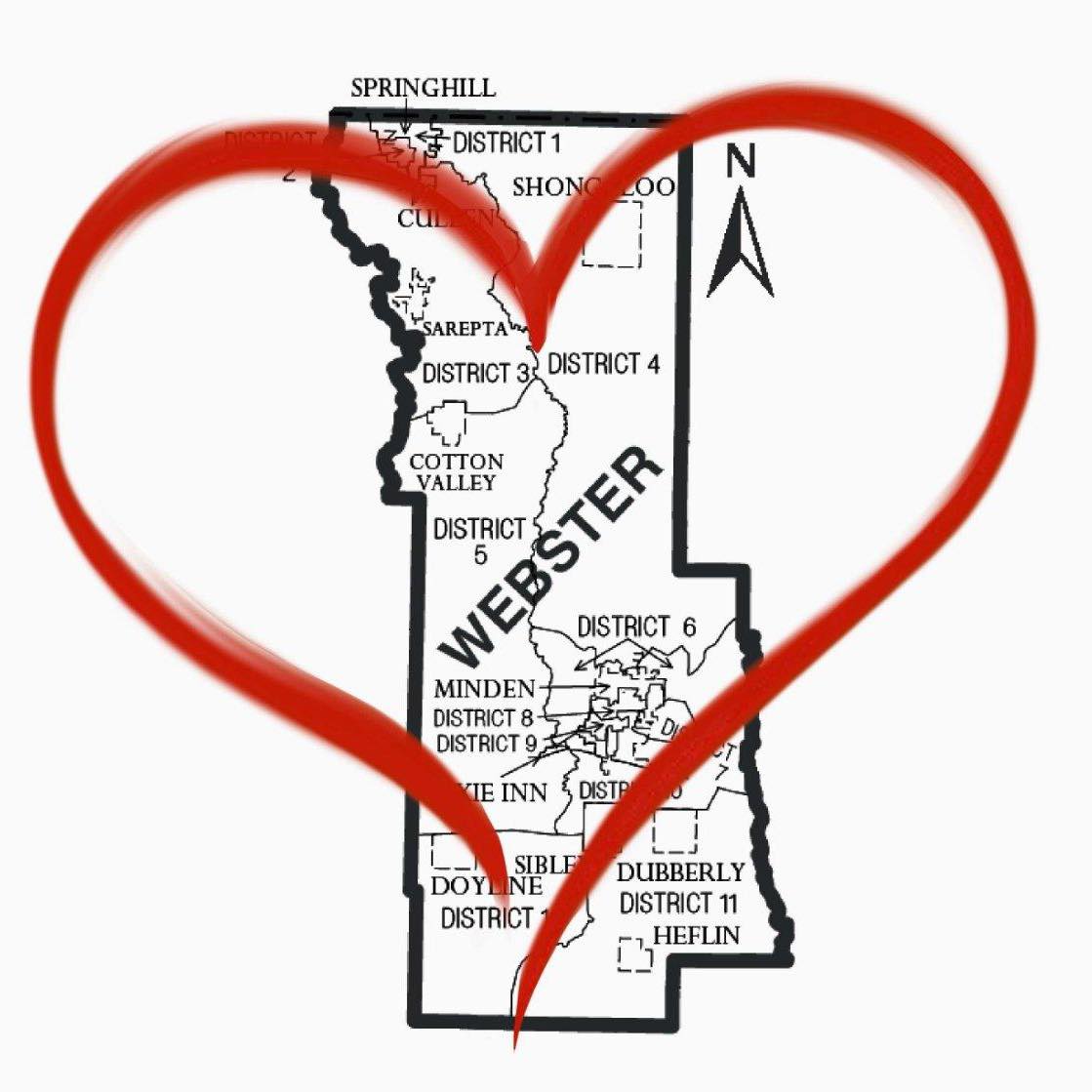
Webster Parish has waited long enough.
When the Church–Parker scandal first became public, the issue was not small. Heart of Webster reported allegations involving a state inmate, Carlton Church, who was serving a 30-year sentence, allegedly living outside normal jail housing, allegedly operating a marked sheriff’s patrol vehicle, allegedly using a personal cellphone, and allegedly being counted as present inside the jail despite claims that he was not housed there in the ordinary manner. Heart of Webster also reported that more than 10,020 inmate counts may have been falsified as part of that arrangement.
This was not a rumor about office politics. This was not gossip. This involved custody, public safety, public records, law-enforcement equipment, inmate supervision, and the authority of an elected sheriff.
And still, to this day, the public has not seen a full public explanation, a public corrective action plan, or a public accounting from the people responsible.
So now the question is no longer only for Sheriff Jason Parker.
The question is for the people of Webster Parish.
The question is for every elected official who has stayed quiet.
The question is for every Jason Parker supporter who still says this does not matter.
Are you OK with this?
Carlton James Church was convicted of manslaughter in the death of a co-worker and sentenced to 30 years in prison at hard labor, according to a 2012 KSLA report. Louisiana law lists manslaughter as a “crime of violence.” Heart of Webster later reported that Church was allegedly placed in the Webster Parish Sheriff’s Auto Center, an environment involving vehicles, tools, equipment, movement, and reduced confinement concerns.
So the question must be asked plainly:
Would an ordinary person receive this much silence?
Would an ordinary deputy receive this much protection?
Would an ordinary jail employee be allowed to explain this away without documents, public review, or consequences?
Would an ordinary citizen be told, “It is fine, just move on”?
Louisiana law also treats telecommunications equipment, including cellular phones, as contraband in correctional facilities unless legally authorized, and the law prohibits giving or attempting to give contraband to an inmate. If the public is expected to respect the law, then public officials must be expected to answer when serious questions arise about whether those laws were followed.
This is where Parker supporters need to be honest.
Support is one thing. Blind loyalty is another.
If you support Sheriff Parker, do you support this?
Do you support an inmate convicted of a violent offense allegedly being placed in an unsecured or work-like environment?
Do you support a convicted inmate allegedly driving a marked sheriff’s vehicle?
Do you support silence when the public asks who authorized it?
Do you support elected officials staying quiet because the person involved is politically connected, personally liked, or locally powerful?
If the answer is no, then the next question is simple:
What are you willing to say publicly?
Because silence is not neutral anymore.
Heart of Webster previously documented how the timeline moved from questions, to records, to unanswered public concern. That timeline showed no comprehensive public statement, no clear public walkthrough, and no visible effort to close the loop for the community. A later update reported that Brian P. Bass submitted a sworn statement and supporting materials, and that during a December 15, 2025 call with Rep. Wayne McMahen, no commitment was made to review the evidence in detail, contact investigators, initiate legislative oversight, or pursue additional inquiry, according to the statement described by Heart of Webster.
That matters.
Because when officials do not answer, the public starts learning a dangerous lesson: accountability depends on who you are.
That is not law and order.
That is selective protection.
Local media silence has also become part of the story. Heart of Webster previously asked why larger news outlets had not meaningfully reported on the Church–Parker scandal, noting that mainstream reporting had been absent or limited despite serious allegations involving a sheriff, a convicted inmate, custodial practices, and public trust. Meanwhile, Sheriff Parker continued receiving public-facing coverage about his leadership and six years of service, including a February 2026 Minden Press-Herald article quoting him on trust, cooperation, training, and public service.
That contrast is exactly why this update matters.
The public has heard about accomplishments.
The public has heard about image.
The public has heard about training centers, partnerships, and future plans.
But where is the public explanation for the Church–Parker allegations?
Where is the independent review?
Where is the answer to who approved what?
Where is the explanation of the count sheets?
Where is the explanation of the cellphone?
Where is the explanation of the patrol vehicle?
Where is the explanation of the Auto Center placement?
Where is the accountability?
This is not about hating Sheriff Parker. This is not about politics. This is not about attacking supporters.
It is about whether Webster Parish still believes rules apply to powerful people.
It is about whether public office comes with public accountability.
It is about whether supporters can separate friendship, politics, and image from facts, records, and responsibility.
So again:
Are you OK with this?
If you are not OK with it, then say so.
Ask for a public response.
Ask for an independent investigation.
Ask for the records.
Ask why the public has not received a full explanation.
Ask why elected officials have not demanded answers.
Ask why silence has been allowed to do the job that accountability should have done.
Because if this can happen and nothing publicly changes, then Webster Parish has a much bigger problem than one scandal.
It has a system that teaches the powerful they can wait out the public.
And it teaches the public that asking questions does not matter.
That cannot be allowed to become normal.
What Accountability Should Look Like Now
At minimum, Webster Parish deserves:
A public statement addressing each major allegation.
An independent review by an outside agency with no local political ties.
A review of inmate housing records, work assignment records, transportation records, count sheets, and cellphone-related evidence.
A clear explanation from any elected official who received information and failed to act publicly.
A commitment that no inmate, no sheriff, and no public official is above the law.
Until that happens, this matter is not closed.
It is unresolved.
And every person defending the silence should be asked one question:
If this were someone you did not support, would you still be OK with it?
Publisher’s Note
All individuals named are presumed innocent unless and until proven otherwise through the appropriate legal process. This article is based on prior public reporting, public records, and unresolved questions of public concern. The purpose is not to convict anyone in the court of public opinion, but to demand transparency, accountability, and equal treatment under the law.
Links to Articles with full documentation
Why Local News Has Not Reported on the Church–Parker Scandal
If Nothing Changes: What the Church–Parker Scandal Could Mean for Webster Parish
UPDATE: CHURCH-PARKER SCANDAL – What Happened After the Call With Rep. Wayne McMahen?
The Timeline — How the Church–Parker Scandal Unfolded, and Where the Silence Began
BREAKING: Crime of Violence Inmate Allegedly Placed in Prohibited Work Assignment
The Oversight Question — Who Was Supposed to Step In, and Why the Public Never Saw It
The Psychology of Silence: What the Public Hears When a Leader Says Nothing
Rules for Thee, Not for Me: Why the Law Feels Optional for the Powerful


