


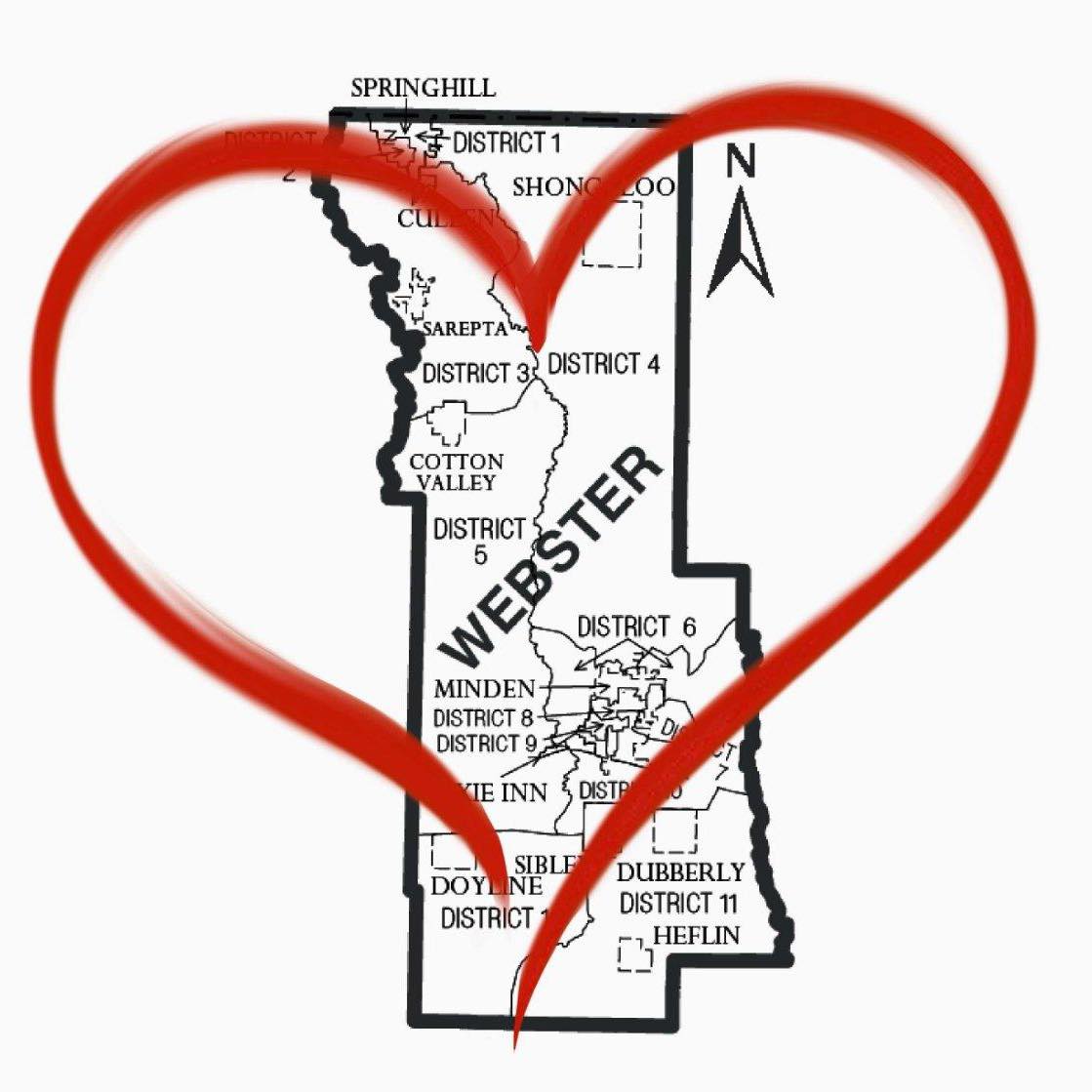
The growing controversy surrounding Webster Parish Sheriff Jason Parker is no longer about one Facebook post, one deleted comment, or one unanswered question. It is about public trust, equal justice, and whether elected officials in Webster Parish are being held to the same standard as ordinary citizens.
At the center of the concern is the Webster Parish Sheriff’s Office’s use of Facebook to release official information to the public. According to screenshots and information reviewed for this story, comments critical of Sheriff Jason Parker or questioning the sheriff’s version of events appear to have been deleted or hidden from public view.
That matters because an official government Facebook page is not the same thing as a private fan page. When a sheriff’s office uses Facebook to release public safety information, official statements, agency updates, or responses to public controversy, the page becomes part of the government’s communication system.
If the public is allowed to comment on that page, the comment section may become a public forum or limited public forum under First Amendment law. In that setting, the government may enforce neutral rules against threats, spam, obscenity, private personal information, or clearly off-topic content, but it cannot delete comments simply because the comments criticize the sheriff, challenge the department’s story, or make the agency look bad.
That distinction is the heart of this story. The issue is not whether the sheriff’s office can moderate its page at all; the issue is whether the office is using moderation as a shield to silence criticism and protect Sheriff Parker from public questions.
The Church–Parker Scandal Raises Questions That Cannot Be Deleted
The deleted-comment issue becomes even more serious because it is tied to what many citizens now refer to as the Church–Parker scandal. According to information provided to this publication, the scandal involves allegations that Sheriff Jason Parker’s office allowed state inmate Carlton Church, described in prior reporting as a convicted killer serving a lengthy prison sentence, to operate outside normal custody and drive a marked Webster Parish patrol vehicle.
Those allegations, if accurate, are not minor. They raise serious questions about inmate custody, work-release authority, public safety, access to law-enforcement equipment, and whether criminal justice information systems may have been placed at risk.
The public has every right to ask who authorized the arrangement, what policies allowed it, whether the inmate had access to radios or mobile data equipment, and whether any law-enforcement database or sensitive public safety system was exposed. The public also has every right to ask whether Sheriff Parker’s office is now attempting to control the narrative by deleting critical comments from an official government page.
No court cited in this article has found Sheriff Parker guilty of a crime in connection with these allegations. That point should be made clearly, because accusations and court findings are not the same thing.
However, the public does not need a conviction before it can ask questions. The public does not need permission from the courthouse before it demands records, explanations, and an outside review.
Court Cases Show Why Deleted Comments May Be Illegal
The strongest legal case for the deleted-comment issue is Robinson v. Hunt County, a 2019 decision from the United States Court of Appeals for the Fifth Circuit. That case matters directly because Louisiana is in the Fifth Circuit, and the dispute involved a sheriff’s office Facebook page.
In Robinson, a citizen alleged that the Hunt County Sheriff’s Office deleted comments critical of the sheriff’s office and banned her from the Facebook page. The Fifth Circuit held that the plaintiff had sufficiently pleaded an official policy of viewpoint discrimination on the sheriff’s office Facebook page, which allowed the claim against the county to move forward.
That case should be a warning to every sheriff’s office in the Fifth Circuit, including Webster Parish. A sheriff’s office cannot open an official Facebook page, invite public engagement, and then remove criticism simply because officials label it “inappropriate” or because it makes the sheriff look bad.
The United States Supreme Court also addressed public officials and social media in Lindke v. Freed in 2024. The Court held that a public official’s social media action can be treated as state action when the official had actual authority to speak for the government on the matter and appeared to exercise that authority in the relevant post.
That rule matters because a First Amendment civil-rights claim under 42 U.S.C. § 1983 generally requires government action. When a sheriff’s office page is used to release official information, respond to public issues, and manage comments from citizens, the argument for state action becomes much stronger.
The Supreme Court’s companion case, O’Connor-Ratcliff v. Garnier, involved public officials who blocked critics on social media. The case was sent back to the lower courts to apply the Lindke standard, which means courts must examine whether the official had authority to speak for the government and whether the official appeared to use that authority through the social media account.
Another important case is Davison v. Randall from the Fourth Circuit. In that case, the court held that the interactive portion of a local official’s Facebook page was a public forum and that the official engaged in unconstitutional viewpoint discrimination by banning a critic from that forum.
These cases point in the same direction. If a public official or government agency uses a social media page as an official communication tool, allows public comment, and then blocks or deletes criticism because of the viewpoint expressed, the government may be violating the First Amendment.
That is why the screenshots matter. Each deleted or hidden comment may be evidence of whether the sheriff’s office applied a neutral moderation policy or whether it removed speech because the speech was critical of Sheriff Parker.
Viewpoint Discrimination Is Not Moderation
Government officials often try to defend deleted comments by calling them “inappropriate,” “negative,” or “disruptive.” That kind of language may sound reasonable to the public, but courts look deeper than labels.
The question is not whether a comment was uncomfortable. The question is whether the comment was removed because of its viewpoint.
A citizen asking why Sheriff Parker allowed an inmate near a patrol vehicle is expressing a viewpoint. A citizen saying the sheriff’s explanation does not match the facts is expressing a viewpoint. A citizen asking why the District Attorney will not act against elected officials is expressing a viewpoint.
Those questions may irritate elected officials, but they are core political speech. Speech criticizing government officials sits at the center of what the First Amendment was designed to protect.
A sheriff’s office does not have to agree with citizens. It does not have to enjoy criticism. It does not have to answer every comment posted online.
However, if the office operates an official government page and opens the comment section to the public, it cannot silence people simply because their speech challenges the sheriff’s credibility or damages the department’s preferred narrative.
Deleted Comments May Also Be Public Records
The Facebook issue may also raise public-records concerns. If the Webster Parish Sheriff’s Office is using Facebook to conduct official public business, then posts, comments, messages, moderation actions, deletion logs, and internal communications about the page may be public records.
That means deleted comments should not simply disappear into the digital trash. The public has a right to ask whether those comments were preserved, who deleted them, what policy was used, and whether the deleted comments were removed for lawful reasons or political reasons.
The sheriff’s office should be asked to produce every deleted or hidden Facebook comment related to Sheriff Jason Parker, Carlton Church, the Church–Parker scandal, and any official public statements connected to those issues. The request should also seek moderation logs, screenshots, Meta/Facebook administrator activity, internal communications, social media policies, and the names or titles of employees with administrator or moderator access.
If the sheriff’s office did nothing wrong, the records should help prove it. If comments were removed because they violated a neutral policy, the records should show that.
If, however, comments were removed because they criticized Sheriff Parker, exposed contradictions, or asked questions the department did not want to answer, then the records may show something much more serious than poor social media management.
The District Attorney Question
The questions surrounding Sheriff Parker do not stop with the sheriff’s office. They also reach the office of the District Attorney, because the public wants to know who is supposed to hold elected officials accountable when serious allegations involve people with political power.
The District Attorney for Bossier and Webster Parishes is John “Schuyler” Marvin, who has served as District Attorney for the 26th Judicial District since January 13, 2003, according to the official district attorney website.
According to a confirmed report from a police chief provided to this publication, the District Attorney will not file charges against an elected official during an election year because of concern over upsetting the public. The same report claims the DA generally only pursues cases after someone has already been arrested.
If accurate, that statement cuts directly to the heart of public trust. A district attorney is not elected to protect political comfort; a district attorney is elected to review evidence, apply the law, and make charging decisions based on facts.
The concern is not that every complaint should result in criminal charges. Prosecutors have discretion, evidence matters, and not every allegation meets the legal burden required for prosecution.
The concern is whether elected officials are being treated differently than ordinary citizens. If a prosecutor refuses to act against elected officials during an election year because the case may upset the public, then the justice system begins to look less like independent law enforcement and more like political damage control.
Complaints Against Two Elected Officials Reportedly Went Nowhere
According to information provided to this publication, complaints were filed with local police against two separate elected officials. These were reportedly formal complaints made through law-enforcement channels, not casual rumors or random social media accusations.
Despite that, the District Attorney allegedly refused to file charges in both cases. That decision raises a serious question about whether elected officials in Webster Parish are being reviewed under the same standard as everyone else.
When an ordinary person is accused of wrongdoing, the process often moves quickly. A complaint is made, a report is written, an arrest may follow, charges may be filed, and the accused person is left to fight the case in court.
When the accused person holds elected office, the public is now left wondering whether a different process exists behind closed doors. That perception alone damages confidence in the justice system, especially when the parish is already dealing with allegations involving the sheriff, deleted public comments, inmate custody, and possible misuse of official authority.
If the District Attorney’s office cannot review complaints involving elected officials without the appearance of political conflict, those matters should be referred to an outside prosecutor or state-level agency. The people deserve a review by someone with no political interest in protecting the sheriff, the courthouse, or the local power structure.
How Many Laws May Have Been Violated?
Many citizens are asking how many laws may have been broken. That question is fair, but it must be answered carefully because accusations are not the same as convictions.
The stronger and more responsible conclusion is that the known allegations and available evidence raise several major legal concerns that deserve outside review. Those concerns include possible First Amendment violations, possible civil-rights exposure under 42 U.S.C. § 1983, possible public-records violations, possible inmate-custody or work-release violations, possible law-enforcement security breaches, and possible abuse-of-office or malfeasance concerns.
The First Amendment issue is straightforward. If an official sheriff’s office page deleted comments because they criticized Sheriff Parker or challenged the department’s version of events, the office may have engaged in viewpoint discrimination.
The civil-rights issue follows from that. If the deletion was done by government officials acting under color of law, affected citizens may have a potential § 1983 claim based on the violation of constitutional rights.
The public-records issue is also serious. If official Facebook comments were deleted or hidden without preservation, the public has a right to know whether government records were destroyed, concealed, or withheld from review.
The inmate-custody issue depends on the facts surrounding Carlton Church. If an inmate was allowed to operate outside lawful custody, drive a marked patrol vehicle, or access law-enforcement equipment without proper authority, then the public deserves to know who approved it and under what legal authority.
The law-enforcement security issue may be even more serious. If an inmate had access to radios, patrol computers, mobile data terminals, or criminal justice information systems, then the matter should be reviewed by an outside agency familiar with law-enforcement data security requirements.
Finally, the abuse-of-office concern cannot be ignored. If any public official knowingly used official authority to protect a political ally, silence critics, avoid public accountability, or treat elected officials differently from ordinary citizens, then the issue moves beyond bad judgment and into the realm of possible official misconduct.
The Good Old Boy System Survives Through Silence
People do not lose trust in government because they ask too many questions. They lose trust because government refuses to answer them.
They lose trust when public officials delete criticism instead of responding to it. They lose trust when elected officials appear protected while ordinary citizens are prosecuted.
They lose trust when law enforcement asks for public support but refuses public accountability. They lose trust when prosecutors appear more concerned about political fallout than equal justice.
That is how the good old boy system survives. It does not always survive through loud corruption in broad daylight; sometimes it survives through quiet refusals, delayed action, deleted comments, ignored complaints, protected relationships, political calculations, selective enforcement, and the hope that the public will eventually get tired and move on.
The public should not move on from this. The allegations involve a sheriff, a state inmate, a marked patrol vehicle, law-enforcement equipment, deleted comments from an official government page, complaints against elected officials, and a District Attorney who is reportedly unwilling to pursue elected officials during an election year.
Those are not separate issues. Together, they form a pattern that demands outside review.
The Case for an Outside Investigation
The people of Webster Parish deserve more than statements from the same offices being questioned. They deserve an independent review by an agency or prosecutor with no stake in protecting local political relationships.
If Sheriff Parker and the Webster Parish Sheriff’s Office did nothing wrong, an outside review can help clear the air. If the District Attorney’s decisions were proper, an outside review can explain why the complaints did not result in charges.
If the Facebook comments were deleted for lawful reasons, an outside review can confirm that. If the comments were deleted because they criticized Sheriff Parker, challenged official statements, or exposed contradictions, then the public deserves to know that too.
The answer cannot be more silence. The answer cannot be more deleted comments, more courthouse whispers, more political excuses, or more demands that the public simply trust the same officials whose conduct is being questioned.
The public should demand preservation of all records, release of moderation logs, disclosure of social media policies, production of complaint records, and referral of the matter to an outside agency or independent prosecutor.
At the center of this controversy is one basic principle that should not be controversial. No elected official is above the law, whether that official is a sheriff, prosecutor, mayor, council member, or anyone else entrusted with public power.
The people of Webster Parish deserve a justice system that works the same for the powerful as it does for everyone else. Until that happens, the questions surrounding Sheriff Jason Parker, the deleted comments, the Church–Parker scandal, and the District Attorney’s refusal to act will not go away.
They will only get louder.


All of this Corruption in Cullen could of been prevented, if the Aldermans would of stood up and done their Jobs. They were warned, but didn’t listen.